



Before looking at providers, it’s worth grounding what implementation really means.
A proper Microsoft Dynamics 365 implementation service goes beyond setup. It typically includes:
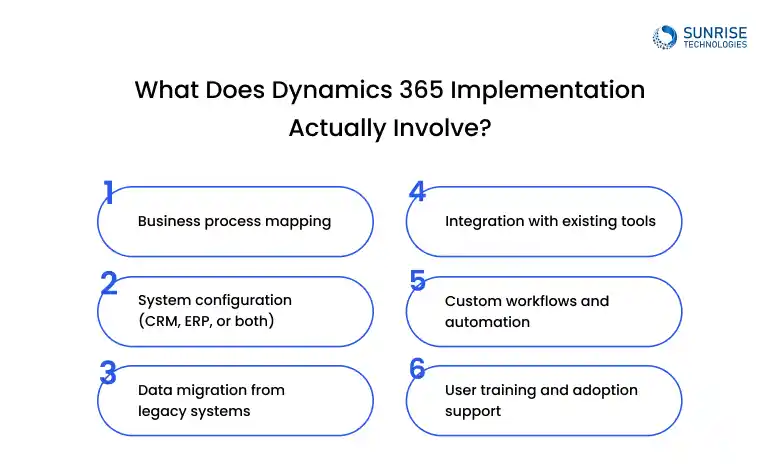
- Business process mapping
- System configuration (CRM, ERP, or both)
- Data migration from legacy systems
- Integration with existing tools
- Custom workflows and automation
- User training and adoption support
In reality, most challenges don’t come from the software—they come from how well it’s aligned with your business processes.
This is where many projects struggle.
Some of the most common challenges include:
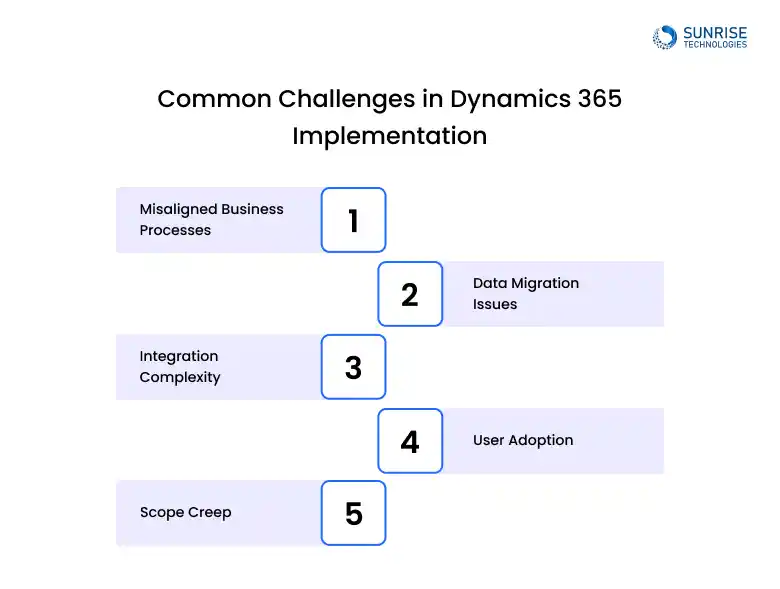
1. Misaligned Business Processes
Trying to fit existing processes into the system without redesigning them often leads to inefficiencies.
2. Data Migration Issues
Incomplete or inconsistent data can slow down adoption and reduce trust in the system.
3. Integration Complexity
Connecting Dynamics with existing systems—finance tools, CRMs, or third-party apps—can become more complex than expected.
4. User Adoption
Even the best system fails if teams don’t use it properly.
5. Scope Creep
Without clear planning, implementation timelines and budgets can quickly expand.
Understanding these challenges is key when choosing a Dynamics 365 implementation company in Australia.
Below is a curated list of companies offering Dynamics 365 implementation services in Australia, with a focus on practical delivery capability.
1. Sunrise Technologies

Sunrise Technologies focuses on delivering practical, integration-led Dynamics 365 implementations for mid-sized and enterprise businesses. Most Dynamics 365 projects struggle not because of the platform, but because it’s implemented in isolation. Sunrise takes a different approach—treating Dynamics as part of a broader business system, not just a standalone deployment.
Core Capabilities
Sunrise Technologies covers the full lifecycle of Microsoft Dynamics 365 implementation services, including:
- Dynamics 365 CRM and ERP implementation
- Microsoft Dynamics 365 Business Central deployment
- Finance & Operations system rollout
- End-to-end system integration (Microsoft + third-party platforms)
- Workflow automation and process optimisation
- Data migration and system consolidation
Their strength lies in building connected systems, not isolated modules.
Why They Stand Out
Rather than taking a generic deployment approach, Sunrise focuses on building systems that reflect how businesses actually operate. This makes them a strong choice for companies looking to hire a Dynamics 365 implementation partner in Australia for long-term outcomes.
2. ERBrains

ERBrains provides Microsoft Dynamics solutions with a focus on ERP systems.
Key Capabilities
- Dynamics 365 Finance and Operations implementation
- ERP transformation projects
- Industry-focused solutions
Positioning
Well-suited for organisations looking for a structured Dynamics 365 ERP implementation in Australia.
3. DHRP

DHRP works across Microsoft technologies including Dynamics and Microsoft 365.
Key Capabilities
- CRM and ERP implementations
- Business process consulting
- Microsoft ecosystem solutions
Positioning
Suitable for businesses needing a broader Microsoft partner, alongside implementation.
4. Blue Shield

Blue Shield offers IT and Microsoft solutions, including Dynamics 365.
Key Capabilities
- Cloud and infrastructure services
- Microsoft solutions implementation
- Business IT support
Positioning
A fit for organisations seeking implementation alongside IT services.
5. Dynamics Square

Dynamics Square focuses specifically on Microsoft Dynamics solutions.
Key Capabilities
- Dynamics 365 CRM and ERP implementation
- Industry-specific solutions
- Customisation and support
Positioning
A specialised Microsoft Dynamics implementation company.
6. Walker Scott

Walker Scott works closely with organisations on Dynamics implementations and advisory.
Key Capabilities
- CRM and ERP implementations
- Business transformation
- Microsoft-focused solutions
Positioning
Strong in aligning technology with business processes.
7. iCatalyst

iCatalyst provides Microsoft solutions including Dynamics.
Key Capabilities
- Microsoft cloud solutions
- Dynamics implementation
- Digital transformation
Positioning
Suitable for organisations adopting broader Microsoft solutions.
8. Beyond CRM

Beyond CRM specialises in CRM-focused Dynamics implementations.
Key Capabilities
- Dynamics 365 Sales and Customer Service
- CRM optimisation
- Workflow automation
Positioning
Best for businesses focusing on customer engagement systems.
9. Dynamics Smartz

Dynamics Smartz delivers Microsoft Dynamics services globally, including Australia.
Key Capabilities
- CRM and ERP implementation
- Customisation
- Support services
Positioning
A scalable option for organisations needing flexible delivery.
10. TechEngine

TechEngine offers Microsoft Dynamics services with a focus on implementation.
Key Capabilities
- Dynamics 365 implementation
- System integration
- Microsoft solutions
Positioning
Suitable for businesses looking for practical deployment support.

Dynamics 365 implementation is the process of setting up, configuring, and integrating Microsoft’s CRM and ERP systems into your business. It typically includes system setup, data migration, workflow configuration, integrations, testing, and user training.
Costs vary depending on business size and complexity. Smaller projects can start around $10,000–$30,000, while mid-sized implementations often range higher depending on integrations and customisation.
Enterprise-level projects can go well beyond that based on scope.
Most implementations take between 3 to 6 months for mid-sized businesses. Simpler deployments can be completed faster, while complex ERP and integration-heavy projects may take longer.
A Dynamics 365 implementation partner helps design, configure, and deploy the system based on your business needs. They also handle integrations, data migration, and ensure the system works effectively after go-live.
Look for a partner with strong experience in your industry, proven implementation projects, and integration expertise. It’s also important they understand your workflows and not just the software.
Common challenges include data migration issues, poor system integration, low user adoption, and unclear project scope. Many of these problems arise when implementation is not aligned with real business processes.
Yes. Dynamics 365 is widely used by mid-sized businesses to unify CRM, ERP, and operations. It helps improve visibility, reduce manual work, and scale systems as the business grows.
CRM implementation focuses on customer management, sales, and service processes, while ERP implementation covers finance, operations, supply chain, and internal business processes. Many businesses implement both together.
Not always. Many businesses start with standard features. However, customisation becomes important when workflows, reporting, or integrations don’t match business needs.
ROI typically comes from improved efficiency, reduced manual work, better reporting, and more connected systems. Over time, businesses benefit from faster decision-making and scalable operations.








Cloud Based Project Management Platform
Read the challenges we faced and how we helped
View Case Study