


Power Platform is often marketed as “low-code,” which leads many businesses to believe they can manage everything internally.
In reality, most companies run into issues like:
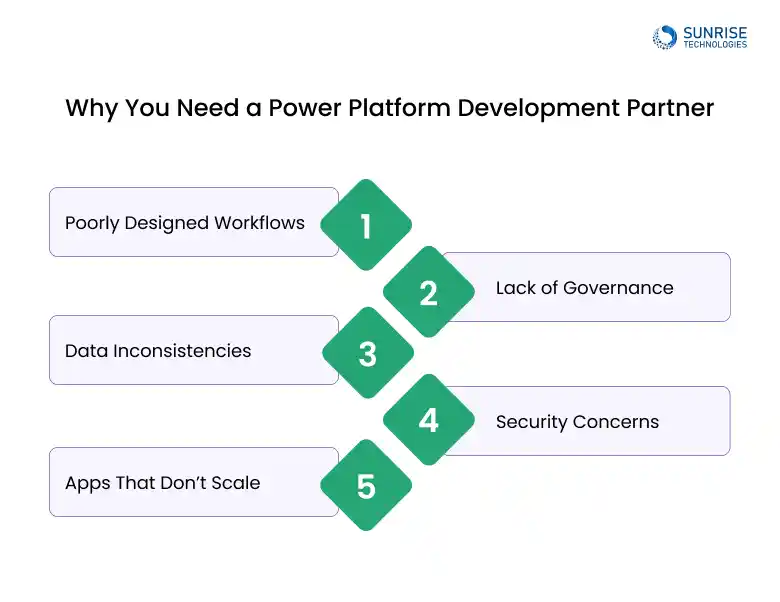
- Poorly designed workflows
- Lack of governance
- Data inconsistencies
- Security concerns
- Apps that don’t scale
A good Power Platform partner helps you:
- Design structured solutions (not one-off apps)
- Ensure proper data flow across systems
- Build scalable and maintainable applications
- Set governance and security standards
- Align solutions with business processes
The difference is simple: Without a partner, you build tools. With the right partner, you build systems.
1. Sunrise Technologies (Australia)

For businesses looking to move beyond basic automation and actually build connected systems, Sunrise Technologies stands out as a strong Power Platform partner in Australia.
Unlike firms that focus only on quick app builds, Sunrise approaches Power Platform as part of a broader operational system—connecting apps, workflows, data, and reporting into one structured environment.
What Sunrise Helps You Achieve
- Reduce manual work across teams by 25–40% through workflow automation
- Replace spreadsheets and disconnected tools with structured apps
- Improve reporting visibility with real-time dashboards
- Connect systems across CRM, ERP, and internal operations
Core Capabilities
- Power Apps development for internal business systems
- Workflow automation using Power Automate
- Power BI reporting and data visibility
- Integration with Dynamics 365, Microsoft 365, and third-party systems
- Governance setup for scalable Power Platform environments
2. C9

C9 is known for delivering Microsoft-based business solutions, with Power Platform forming a key part of their offering.
They focus on:
- Power Apps development for internal tools
- Workflow automation using Power Automate
- Data integration with Microsoft systems
- Reporting through Power BI
C9 is a good fit for organisations looking to modernise operations without completely replacing existing systems.
3. Power Platform Experts Australia

As the name suggests, this company is highly focused on Power Platform.
Their services include:
- End-to-end Power Platform implementation
- Governance and best practices
- Automation and app development
- Training and enablement
They are particularly strong in helping businesses structure their Power Platform environment properly from the beginning.
4. Professional Advantage

Professional Advantage brings long-term experience in Microsoft solutions, including Power Platform.
They offer:
- Business application development
- Data and reporting solutions
- Integration with ERP and CRM systems
- Ongoing managed services
Their strength lies in combining Power Platform with broader business systems.
5. iCatalyst

iCatalyst is an Australian Microsoft specialist with strong Power Platform capabilities.
Their approach includes:
- App development for operations
- Workflow automation
- Integration with Dynamics and other systems
- Support and optimisation
They are well-suited for businesses needing both implementation and long-term support.
6. Avanade (Australia)

Avanade operates at the enterprise level, delivering large-scale Microsoft solutions globally.
In Power Platform, they focus on:
- Enterprise automation
- Advanced integrations
- AI-driven solutions
- Large-scale digital transformation
Avanade is ideal for organisations with complex requirements and large teams.
7. Ascenwork

Ascenwork positions itself as a digital transformation partner with Power Platform capabilities.
They help businesses:
- Automate workflows
- Build internal applications
- Improve operational efficiency
They are a good option for companies looking for practical solutions rather than heavy enterprise setups.
8. ITWorx
ITWorx provides IT and business solutions, including Power Platform services.
Their focus areas include:
- Workflow automation
- Application development
- System integration
They are suitable for organisations wanting a structured implementation without excessive complexity.
9. Ultron Developments

Ultron Developments takes a development-first approach, helping businesses build tailored solutions using Power Platform.
They specialise in:
- Custom app development
- Automation workflows
- System enhancements
Ultron is particularly useful where standard tools don’t fully meet business needs.
10. Aus Indigenous AI

Aus Indigenous AI focuses on delivering innovative digital solutions, including Power Platform-based systems.
They support:
- Automation
- Data-driven solutions
- AI integration
Their positioning is unique in combining Power Platform with broader innovation initiatives.
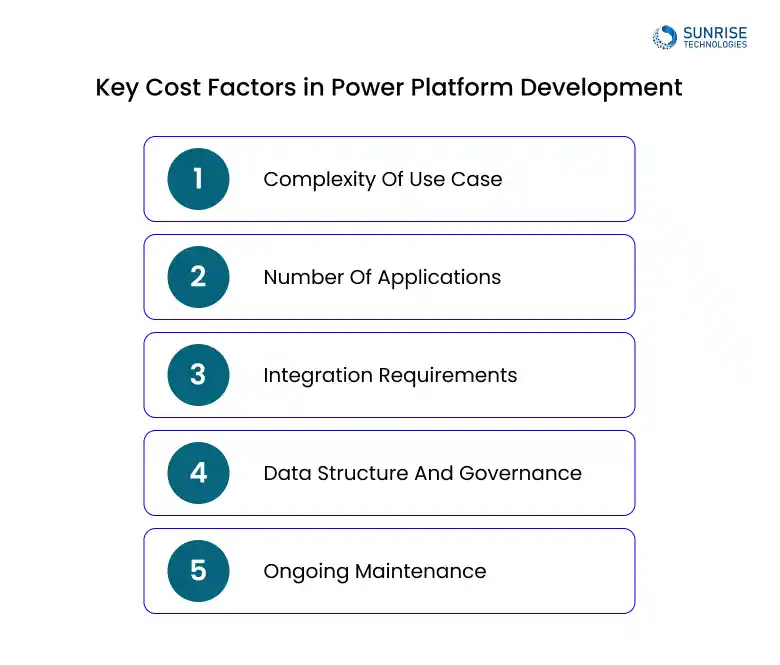
Power Platform projects are often perceived as low-cost, but pricing depends on how deeply the platform is used.
1. Complexity of Use Case
Simple workflow automation is inexpensive. Full operational systems built on Power Apps are not.
2. Number of Applications
A single app is manageable. Multiple interconnected apps increase cost and complexity.
3. Integration Requirements
Connecting Power Platform with:
- ERP systems
- CRM platforms
- External tools
- Adds significant effort.
4. Data Structure and Governance
Poor data design leads to long-term issues. Setting this up correctly requires planning and expertise.
5. Ongoing Maintenance
Power Platform solutions evolve over time. Updates, fixes, and improvements are ongoing costs. The real cost depends on whether you’re building a simple tool or a business-critical system.
There are a few areas where strong partners stand out:
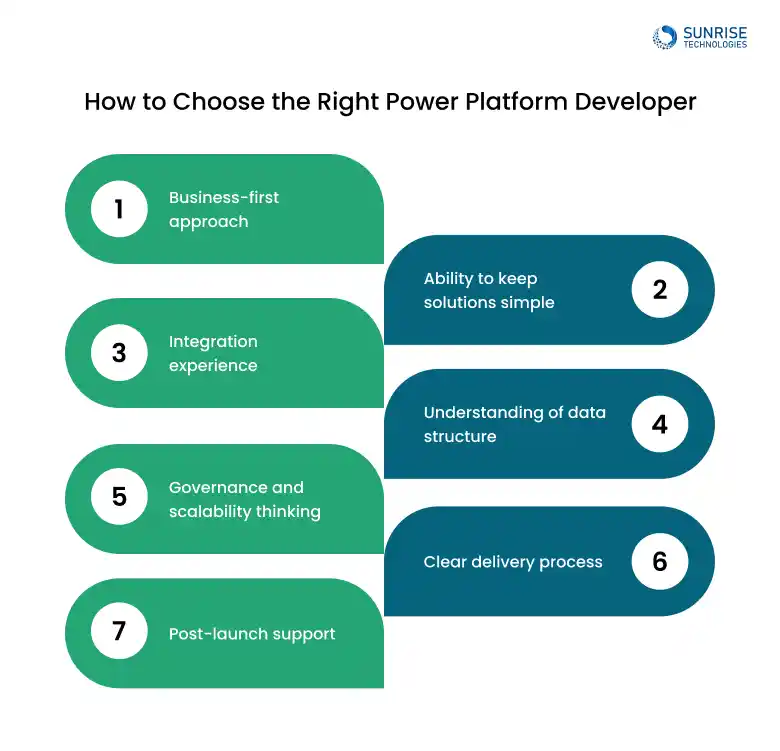
- Business-first approach
They focus on workflows, not just tools. Instead of asking “what do you want to build,” they ask “what problem are you trying to solve?” - Ability to keep solutions simple
Power Platform makes it easy to build quickly, but not everything needs to be complex. The right partner will avoid overengineering and keep solutions easy to use and maintain. - Integration experience
Most Power Platform solutions need to connect with other systems like ERP, CRM, or finance tools. A developer should be comfortable working across systems, not just within Power Platform. - Understanding of data structure
Good solutions are built on clean and structured data. Poor data design leads to reporting issues and broken workflows later. - Governance and scalability thinking
As usage grows, so does complexity. A strong partner will plan for permissions, environments, and standards from the beginning to avoid future chaos. - Clear delivery process
They should be able to explain how the project will move from idea to deployment, including timelines, testing, and rollout. - Post-launch support
Power Platform solutions are rarely “finished.” Ongoing updates, improvements, and fixes are part of the journey.

In most businesses, they’re the person who turns “this is taking too long” into something that runs automatically. That could mean building a simple internal app, fixing a broken workflow, or connecting systems so data doesn’t have to be entered twice.
Usually when teams start relying on manual workarounds—spreadsheets, emails, or repeated data entry. If processes are slowing people down or causing errors, that’s often the point where a developer can step in and simplify things.
It’s commonly used for internal tools—things like approval flows, tracking systems, dashboards, or small apps that sit between bigger systems. A lot of businesses use it to fix gaps where existing software doesn’t quite fit.
There’s no single number. Smaller jobs might be handled in a short engagement, while more involved work—like building apps across departments or integrating multiple systems—can scale up quickly. The key factor is how much logic and integration is involved.
Some solutions are surprisingly quick—especially if the problem is well defined. Others take longer if they involve multiple teams or systems. In most cases, timelines depend less on the tool and more on how clear the requirements are.
For basic use, not really. But once you move beyond simple workflows, having a developer makes a big difference. That’s where things like integrations, custom logic, and long-term maintainability come in.
Yes, and that’s often where it delivers the most value. It can sit between existing systems and help them work together—whether that’s Microsoft tools or third-party platforms.
One common mistake is building quick fixes without thinking about long-term use. Another is trying to do everything internally without the right expertise, which can lead to systems that are hard to maintain later.
In most cases, yes. As processes change, systems need to be updated. Having someone who understands the setup makes those changes much easier
It tends to deliver the most value in areas where people are spending time on repetitive tasks—approvals, reporting, tracking, and data movement between systems.






Cloud Based Project Management Platform
Read the challenges we faced and how we helped
View Case Study