


1. Sunrise Technologies Australia

Location: Australia
Services: Consulting, Implementation, Integration, Custom Development, Support
Sunrise Technologies Australia is a Salesforce consulting company that works with businesses across different stages—from small teams setting up CRM for the first time to larger organisations looking to restructure and integrate existing systems.
Their approach focuses on making Salesforce practical and usable in day-to-day operations rather than over-engineering the system. Projects typically involve aligning CRM workflows with real business processes, connecting Salesforce with other systems, and improving visibility across sales, service, and reporting.
As a Salesforce development company in Australia, Sunrise supports both implementation and ongoing system evolution, helping businesses adapt Salesforce as their operations grow and change.
Their work often includes:
- CRM setup and restructuring based on business workflows
- Integration with ERP, finance, and third-party platforms
- Automation of repetitive sales and service processes
- Reporting improvements for better decision-making
- Ongoing optimisation and support
This makes them a suitable option for organisations that want Salesforce to function as a connected business system rather than just a standalone CRM.
Best for: Businesses of all sizes—from small teams to enterprise organisations—seeking a practical, integration-led Salesforce implementation that improves workflows, system connectivity, and long-term scalability.
2. Techforce Services Australia

Techforce Services positions itself as a strong player in digital transformation and enterprise solutions, with Salesforce forming part of its broader capability.
They focus on:
- Salesforce implementation and support
- Business process automation
- Integration with enterprise systems
- Custom application development
Techforce is suited for organisations that want Salesforce integrated into a wider system landscape rather than used as a standalone tool.
Best for: Enterprise and mid-sized organisations needing Salesforce integrated into a broader digital transformation or multi-system environment.
3. GetNext

GetNext focuses heavily on growth-driven digital solutions, blending CRM strategy with development.
Their Salesforce capabilities include:
- CRM setup and optimisation
- Customer journey mapping
- Sales automation
- Data-driven reporting
They’re a good fit for businesses that want Salesforce aligned closely with marketing and revenue growth rather than just system setup.
Best for: Growth-focused businesses that want Salesforce aligned closely with marketing, customer acquisition, and revenue performance.
4. Ultron Developments

Ultron Developments brings a more development-focused approach, supporting businesses that need tailored Salesforce solutions.
Their strengths include:
- Custom Salesforce development
- Workflow automation
- System enhancements
- App integrations
They’re particularly useful when standard Salesforce features don’t fully match business needs.
Best for: Businesses needing custom Salesforce development where standard features do not fully meet operational requirements.
5. BMP Technologies

BMP Technologies offers CRM and enterprise solutions with Salesforce as part of their service mix.
They typically support:
- CRM implementation
- Business automation
- Data migration
- Reporting setup
BMP works well for businesses looking for a structured, straightforward Salesforce rollout without excessive complexity.
Best for: Small to mid-sized businesses looking for a structured, straightforward Salesforce implementation without unnecessary complexity.
6. 8Squad

8Squad positions itself as a modern digital transformation partner with Salesforce capabilities.
Their approach includes:
- CRM consulting
- Automation workflows
- Integration with digital platforms
- Customer experience improvements
They are suited for businesses aiming to modernise operations with a mix of CRM and digital tools.
Best for: Companies modernising customer experience and digital operations alongside CRM implementation.
7. PSAG Technologies

PSAG Technologies offers a broader IT and consulting service, including Salesforce development and implementation.
Their Salesforce services cover:
- Custom development
- CRM implementation
- Integration with business systems
- Support and maintenance
PSAG is useful for companies looking for a combination of development flexibility and consulting support.
Best for: Businesses looking for a balance of development flexibility and consulting support across CRM and broader IT systems.
8. Vrinsoft Australia

Vrinsoft is a development-focused company with strong experience in Salesforce services.
They provide:
- Salesforce app development
- CRM customisation
- Third-party integrations
- Ongoing technical support
Vrinsoft is a good option for businesses that need hands-on development work rather than just advisory.
Best for: Organisations needing hands-on Salesforce development, app customisation, and technical support.
9. Girikon Australia

Girikon is one of the more recognised Salesforce consulting firms in Australia, with deep platform expertise.
They specialise in:
- Salesforce implementation
- Managed services
- Industry-specific solutions
- Cloud integrations
Girikon is often chosen by businesses that want a dedicated Salesforce-focused partner.
Best for: Businesses seeking a dedicated Salesforce-focused consulting partner with strong platform expertise and managed services.
10. QR Solutions

QR Solutions offers consulting and implementation services across CRM and business systems, including Salesforce.
Their strengths include:
- CRM implementation
- Workflow automation
- Data management
- Reporting and analytics
They are suitable for organisations looking for a practical, no-frills Salesforce deployment.
Best for: Organisations looking for practical Salesforce deployment with a focus on reporting, data management, and workflow efficiency.
When businesses try to estimate Salesforce costs, they often focus only on licensing. In reality, the bigger cost sits in how the system is designed, built, and adopted.
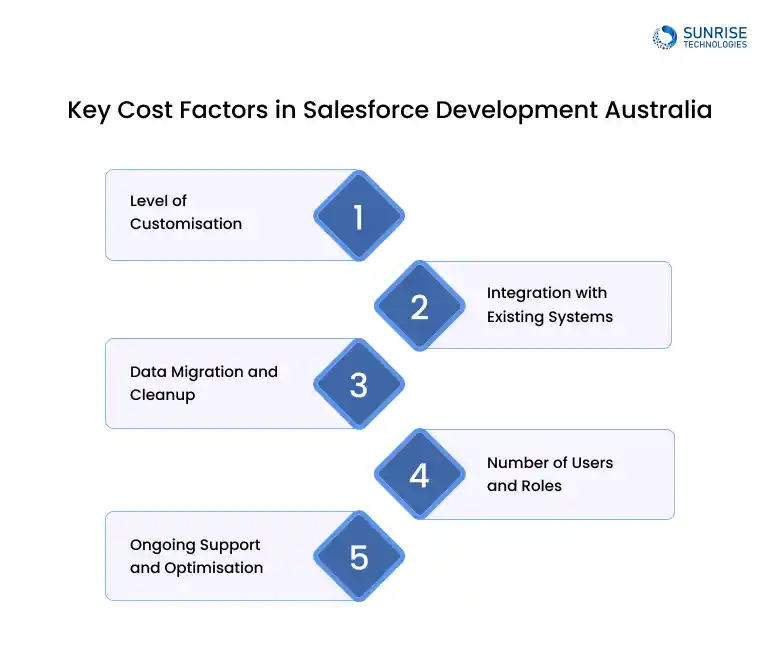
Here are the factors that actually drive cost in a Salesforce project:
1. Level of Customisation
The more you move away from standard Salesforce features, the more development effort is required. Custom objects, workflows, automation, and UI changes all add time and cost.
That said, over-customisation is a common mistake. A good partner will balance custom work with standard functionality to avoid unnecessary spend.
2. Integration with Existing Systems
Very few businesses use Salesforce in isolation. It often needs to connect with:
- ERP systems
- Finance tools
- Marketing platforms
- Internal databases
Each integration requires planning, API work, testing, and ongoing maintenance. The more systems involved, the higher the complexity.
3. Data Migration and Cleanup
Moving data from legacy systems into Salesforce is rarely straightforward.
Many businesses underestimate:
- Duplicate records
- Inconsistent formats
- Missing data
- Historical inaccuracies
Cleaning and structuring data properly is critical—otherwise reporting and automation won’t work correctly.
4. Number of Users and Roles
Cost also depends on how many people will use the system and how differently they use it.
For example:
- Sales teams need pipeline tracking
- Support teams need case management
- Managers need reporting dashboards
Each role may require different configurations, permissions, and workflows.
5. Ongoing Support and Optimisation
Salesforce is not a one-time project. After go-live, businesses need:
- Bug fixes
- Enhancements
- Process improvements
- User training
Ignoring this phase often leads to systems becoming outdated or underused. In simple terms, Salesforce cost is less about “setup” and more about how deeply it becomes part of your operations.
Even with a strong platform like Salesforce, many projects fail to deliver value. In most cases, the issue isn’t the software—it’s how it’s implemented and used.
Here are the most common mistakes:
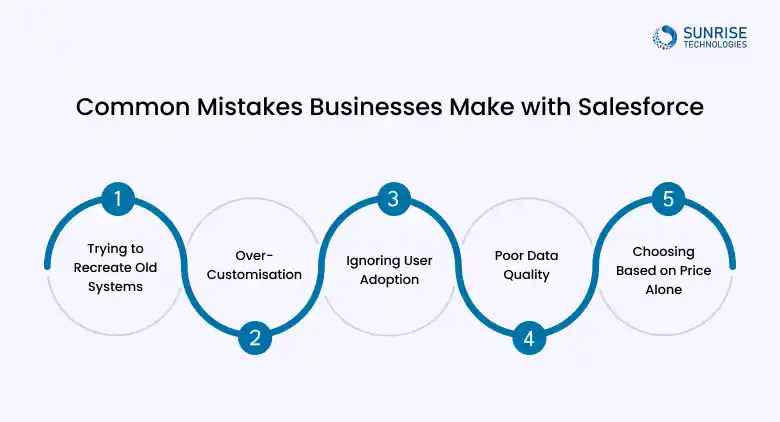
1. Trying to Recreate Old Systems
Many businesses attempt to copy their legacy processes directly into Salesforce.
This leads to:
- Over-complicated workflows
- Poor usability
- Limited improvements
Instead, implementation should be seen as an opportunity to simplify and improve processes, not just replicate them.
2. Over-Customisation
Salesforce allows deep customisation, but that doesn’t mean everything should be customised.
Too much custom work:
- Increases cost
- Slows down the system
- Makes future updates harder
A balanced approach is always better.
3. Ignoring User Adoption
A system is only valuable if people actually use it.
Common adoption issues include:
- Lack of training
- Poor interface design
- Processes that don’t match real workflows
If teams avoid using Salesforce, the entire investment loses value.
4. Poor Data Quality
Bad data is one of the biggest hidden risks.
Issues like duplicates, outdated records, and missing fields lead to:
- Inaccurate reports
- Broken automation
- Poor decision-making
Clean data should be a priority from day one.
5. Choosing Based on Price Alone
Going with the cheapest option often leads to:
- Incomplete implementation
- Limited support
- Expensive rework later
The better approach is to focus on long-term value, not just upfront cost. Most Salesforce problems are preventable with the right planning and the right partner.

Salesforce development costs vary based on complexity, users, and integrations. Small setups may start around $10K, while mid-sized projects range between $25K–$50k. Larger enterprise implementations can exceed that. Costs are mainly driven by customisation, data migration, and integration with other systems.
Most Salesforce implementations take between 6 to 16 weeks. Smaller CRM setups can be completed faster, while complex systems with multiple integrations and custom workflows take longer. Timelines also depend on how quickly internal teams support testing and data preparation.
Basic setup is possible, but most businesses benefit from a Salesforce development company. Without proper planning, systems often become over-complicated or underused. A partner ensures workflows, automation, and integrations are aligned with how your business actually operates.
A Salesforce development company handles system setup, customisation, integrations, automation, and ongoing support. They design workflows, build custom features, connect external systems, and ensure the platform fits your business processes instead of forcing teams to adapt to the software.
Yes, Salesforce can integrate with most systems including ERP, finance tools, marketing platforms, and internal applications. Integration is usually done using APIs or middleware tools. The complexity depends on how many systems are involved and how data needs to flow between them.
Common mistakes include over-customising the system, poor data migration, ignoring user adoption, and choosing the wrong partner. Many businesses also try to replicate old processes instead of improving them, which limits the value of Salesforce.
Yes. Salesforce can be scaled for small and mid-sized businesses, especially with modular setup options. Companies can start with core CRM features and expand over time as their operations grow, without needing to switch platforms.
Choose a partner who understands your business workflows, not just the platform. Look for strong integration experience, a clear delivery process, and ongoing support capability. The right partner focuses on improving operations, not just implementing features.
Most businesses start with Sales Cloud or Service Cloud depending on their priorities. Some begin with Marketing Cloud or Experience Cloud. The right starting point depends on your current processes and where you need the most improvement.
Salesforce improves operations by centralising customer data, automating repetitive tasks, and providing real-time insights. This helps teams work more efficiently, improves visibility across departments, and supports better decision-making.






Cloud Based Project Management Platform
Read the challenges we faced and how we helped
View Case Study